Product passports,
generated automatically.
New EU rules mean products will need a Digital Product Passport to be sold in the EU. Luxima connects to the systems you already use and produces compliant passports for you, across every regulated category. No manual data entry. No sustainability team required.
Luxima — from the Latin lux, “light,” with the superlative -ima: the utmost clarity. The job of a product passport is to bring exactly that — light — to everything you make.
Why Luxima
What makes a passport automatic
Zero-touch
automation
Connect once. Every product you already track becomes a passport, kept current as your data changes.
Every category
covered
Textiles, batteries, furniture, construction, detergents and toys. One platform that follows the regulation as it rolls out.
Verified,
not estimated
Impact figures come from your declared data or from trusted databases, each with a confidence level attached.
Environmental impact · MK-2041
Source: producer declared · confidence high
Inside the portal
Not a roadmap. A working portal.
Luxima is live and in use today. From one workspace you manage the catalogue, publish passports, design how they look, generate compliance evidence and see who is scanning.
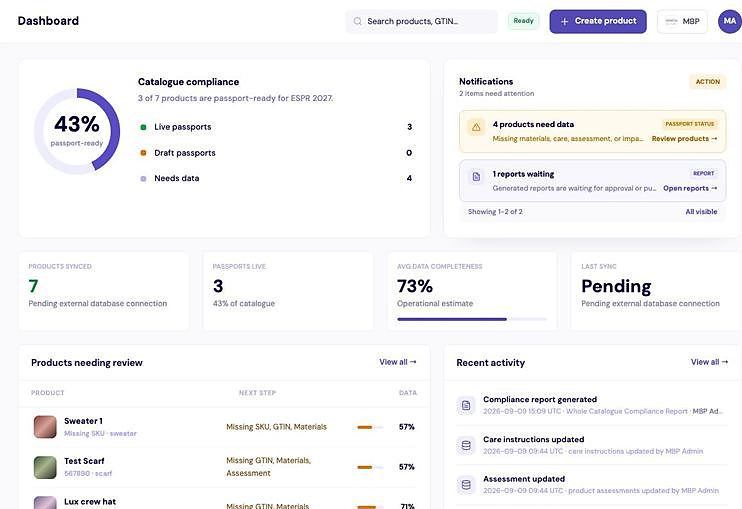
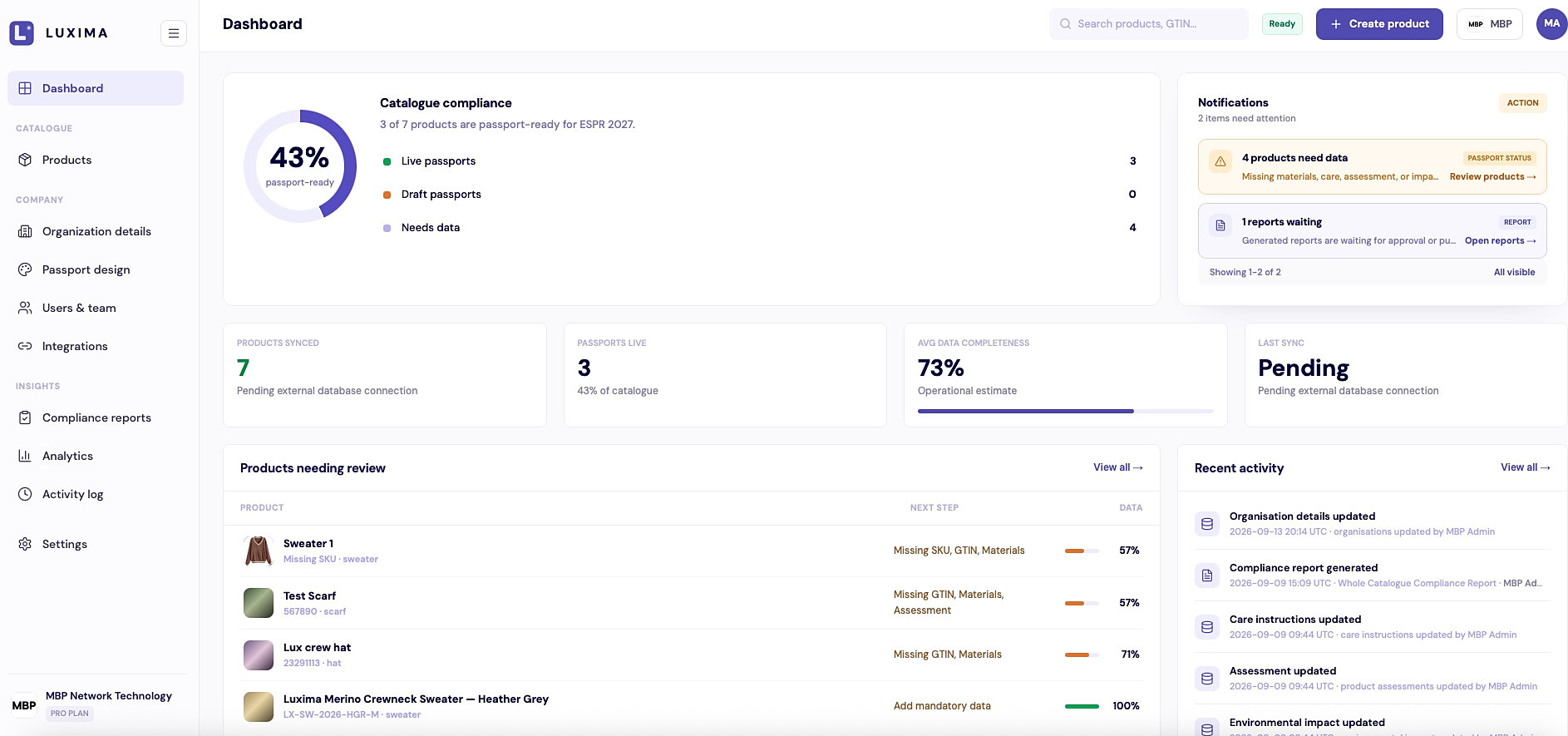
Compliance dashboard
How much of the catalogue is passport-ready, what still needs data, and what changed.
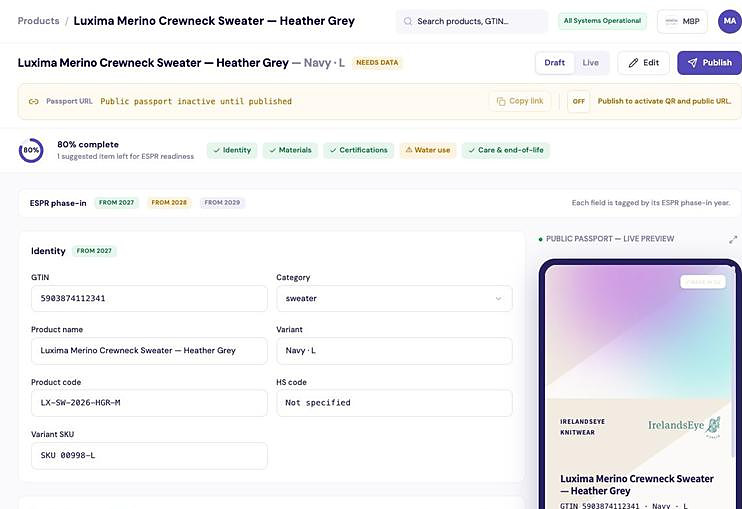
Passport editor
Every field tagged with its ESPR phase-in year, a readiness score, and a live preview of the public passport.
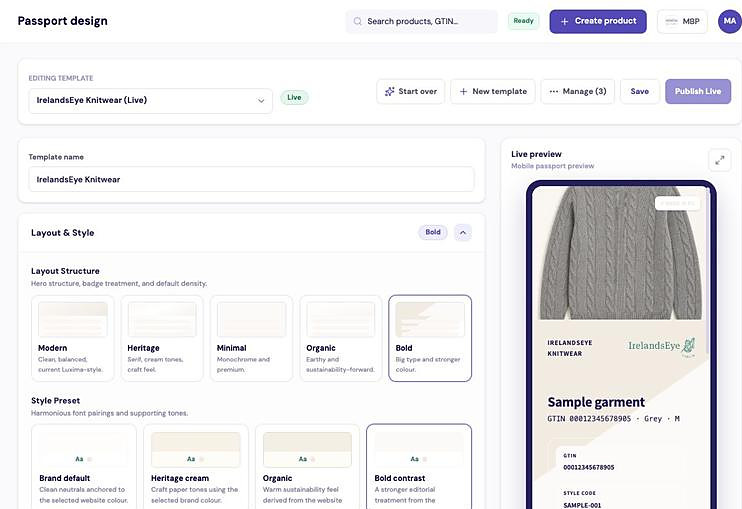
Passport design
Layouts and style presets so the passport your customers scan looks like your brand, not ours.
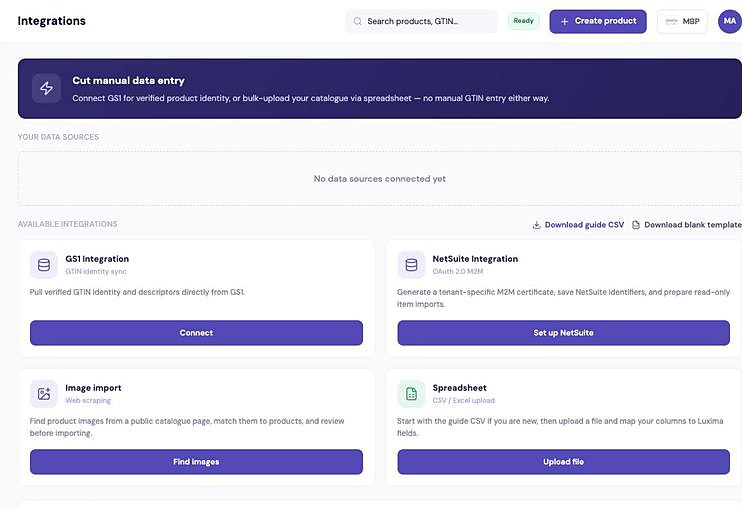
Integrations
Spreadsheet upload with column mapping, GS1, Katana and NetSuite. How they work
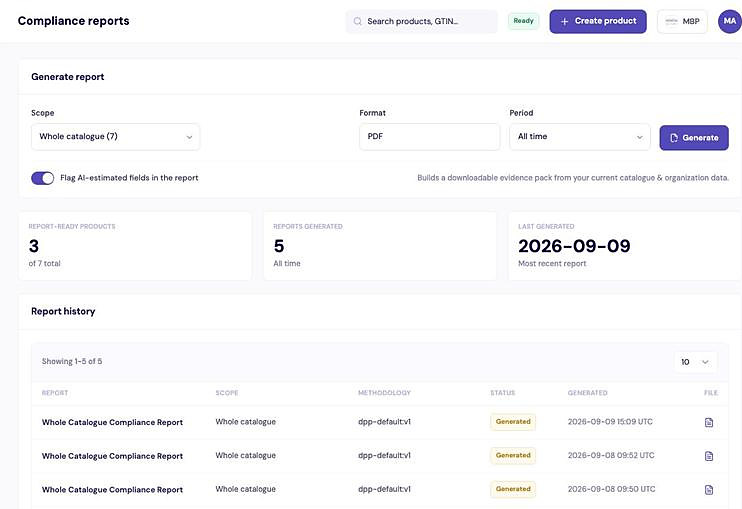
Compliance reports
A downloadable evidence pack for the whole catalogue, a category or one product, with AI-estimated fields flagged.
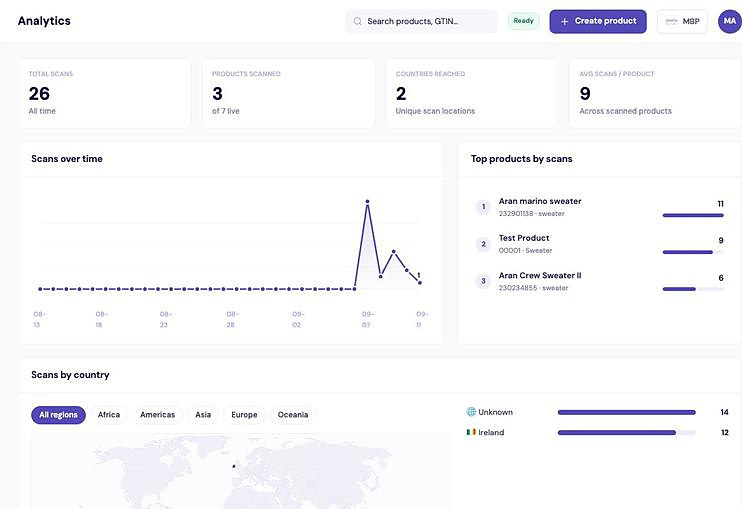
Scan analytics
Which passports get scanned, where, on what device and when, recorded automatically once a passport is live.
From product data to passport
Your data. Connected, checked and passport-ready.
You provide what only you know. Luxima brings in the rest and flags what's missing. Nothing is published until you've confirmed it.
- 1 · You provideWhat only you know
- 2 · Luxima populatesFrom GS1, ERP, suppliers and calculations
- 3 · You approveAI suggestions and anything missing
- 4 · PublishOnly when it's complete

Digital Product Passport
Organic cotton T-shirt
Your Brand · SKU 4471
Completeness100%
25 of 25 required fields
Identity
Materials
Manufacturing
Care & environment
Complete. Every value shows who provided it.
- FreeNo card
- StarterSpreadsheet import
- Growth+ GS1 sync
- Enterprise+ ERP sync
Scale
20,000 products? You won’t enter them one by one.
Typing three fields makes a nice demo. It’s not a workflow. Drop in a spreadsheet, even a messy one, and Luxima maps it. On Growth, connect GS1; on Enterprise, connect Katana, NetSuite or your own systems directly, and passports stay in sync.
Access control
Show what’s required. Protect what’s not.
A Digital Product Passport isn’t all-or-nothing. Some data is public for shoppers; some is restricted to authorities and recyclers. Luxima manages those access tiers for you, so you prove compliance without exposing sensitive supplier, pricing or composition data.
- Field-level access control
- One source, many outputs: public passport, compliance report, API
Public
Shoppers · QR
- Composition
- Care
- End of life
- Impact
- Supplier
- Unit cost
Recyclers
Verified access
- Composition
- Care
- End of life
- Impact
- Disassembly
- Unit cost
Authorities
Full record
- Composition
- Care
- End of life
- Impact
- Disassembly
- Supplier chain
Regulation
The deadline is already on the calendar.
ESPR phases in category by category. Whichever year is yours, the data work starts well before it.
2026
Steel, construction
2027
Textiles, tyres, batteries
2028
Furniture, electronics
2029+
Mattresses, toys, more
Digital Product Passport questions
A Digital Product Passport is a structured digital record of a product's materials, origin, environmental impact and end-of-life information, reachable from a QR code on the product. Under the EU's Ecodesign for Sustainable Products Regulation (ESPR), most products sold in the EU will need one.
Any business placing covered products on the EU market — manufacturers, brands and importers alike, large or small. There is no general exemption for small and mid-sized businesses, so SMEs face the same passport requirement as multinationals.
It rolls out category by category through this decade — batteries and textiles around 2027, furniture about 2028, and most other goods following by 2030. You can see the full timeline on our industries page.
Yes. Irish businesses sell into the EU single market, so the rules apply directly. UK businesses that place products on the EU market must comply too — Brexit didn't change that, because the rules follow the product, not the border.
Typically material composition, country of origin, environmental impact (carbon, water and energy), durability, recyclability and certifications. The exact data points vary by product category and are set by each ESPR delegated act.
Luxima connects to the systems and spreadsheets you already use, calculates what it can, flags what is missing for you to confirm, and generates compliant passports on your own domain — automatically, with far less manual data entry and no sustainability team required.
Get ahead of the deadline.
See how Luxima generates compliant passports for your products, automatically.